
Spare a Thought for Philosophy: An Interview with A.C. Grayling
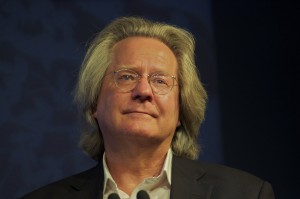 Ian Scott/wikimediacommons
 Bertrand Russell said, ‘Most people would rather die than think; most people do,’” quips the British philosopher A.C. Grayling, leaning forward in his chair at a London café as though offering me a truffle of wisdom for my delectation. Philosophy is a rather strange business in the modern world of consumerism and commerce, I suppose. We’re so used to being force-fed ideas these days that we rarely, if ever, stop and think for ourselves. And that’s where Grayling bucks the trend.
Author of over twenty books, including The Good Book: A Humanist Bible, as well as countless newspaper and magazine columns, Grayling has been a paradigm of humanism for many years: vice president of the British Humanist Association, patron of the UK organization Dignity in Dying, honorary associate of the National Secular Society… the list goes on. And yet, anyone anticipating stuffy Socratic dialogue with a kooky academic or a living, breathing replica of Auguste Rodin’s The Thinker (with added mane), would be taken aback by Grayling’s down-to-earth, congenial presence.
What makes Grayling tick, in his words, is “the fact that the world is so rich in interest and in puzzles, and that the task of finding out as much as we can about it is not an endless task, but certainly one which is going to take us many, many millennia to complete.” There’s a sort of childlike grin that beams out at me, as he affirms: “That’s exciting—discovery is exciting.” Grayling takes pleasure in doubt and possibility, in invention and innovation: the tasks of the open mind and open inquiry. It’s a mindset, he reveals, that “loves the open-endedness and the continuing character of the conversation that humankind has with itself about all these things that really matter.”
It’s also a way of thinking that marks a line in the sand between religion and science. The temptation to fall for the former—hook, line, and sinker—is plain to see: “People like narratives, they like to have an explanation, they like to know where they are going.” Weaving another string of thought into his tapestry of human psychology, Grayling laments that his fellow human beings “don’t want to have to think these things out for themselves. They like the nice, pre-packaged answer that’s just handed to them by somebody authoritative with a big beard.” He looks down towards a small flower arrangement on the table, and plays with it contemplatively before continuing in an almost plaintive tone: “And that is a kind of betrayal, in a way, of the fact that we have curiosity but, most of all, we have intelligence and so we should be questioning, challenging, trying to find out.”
But the pessimism doesn’t persist for too long. Grayling’s biting wit is never too far from the surface of his arguments, especially when he’s waxing lyrical about theology. By tracing what he calls “a kind of Nietzschean genealogy of religion,” he adopts a storyteller’s tone: “You see a geography—and it’s an interesting one—in that the dryads and the nymphs used to be in the trees and in the streams.” After that they evaporated into the wind and the sun, he says, noting that the more humankind has discovered about the world, the more remote our gods have become. “They went from the surface of the earth to the mountaintops, then into the sky, and finally beyond space and time altogether,” Grayling observes. Not only have gods and goddesses retreated into their extraterrestrial hiding places, but they’ve also dwindled in number (generally) to only one or three, depending on your divine arithmetic: “So they’re being chased away bit by bit,” Grayling chuckles.
For all his cutting cogency, there’s an underlying empathy to what he says. Grayling seems desperate to reach out to those he believes are lost in an intellectual fog of their own making, his aim to lend a hand and pull them out. But he’s worried—and rightly so. The problem with extreme strands of Islam, Christianity, Judaism, and Hinduism is self-evident: “They force people to narrow their horizon of vision down so that they are almost blind, almost infantilized, as if in a straitjacket of captivity. But every religion goes through a fundamentalist phase,” he acknowledges in his typically even-handed manner, “and every religion leaves its fundamentalist rump; you can see this very clearly in the case of Christianity.”
Will we ever really outgrow religion, though? Grayling leans against the wall casually, stretching out his legs before responding with an assured brand of optimism: “It seems to me that in five or ten thousand years’ time, when people look back (if there are any people) at this period of history, the two or three thousand years when Judeo-Christian influence in the world was considerable, they will collapse it down to a sentence.” Just as we view the advent of Cro-Magnon humans in Europe in 40,000 BCE and the disappearance of Neanderthals around ten thousand years later as historical events and nothing more, so future historians will consider religion as a mere artifact. Indeed, according to Grayling, they will astutely recognize religious history as “a bad time for human beings, because they were getting cleverer with their technologies, but they were no wiser.”
Still, it’s crucial to Grayling’s philosophical outlook that when we lose faith, we don’t lose hope. “Almost any religion can be explained to another person in about half an hour,” he claims, adjusting his imperious-looking gold-rimmed spectacles. “But to know anything about astrophysics or biology or anything that really gives us an insight into the real beauty of the universe? That takes some years of study at least.” Such logic allows the adversity of a world without faith to be rebranded as opportunity, oblivion as salvation. Grayling pauses briefly, before launching into another gem in his immensely vibrant stash of anecdotes and references: “There’s a writer, a man called J.B. Bury, who wrote a wonderful history of Greece a long time ago now. He talks at one point about the Greeks’ own histories of their city-states, and he writes about one in particular, the kings of which could be traced back to divine origin.” I wait, as though anticipating the punch line of a joke, while he stalls for a second in his recollection. “And Bury effectively says, how boring! It was only a god who founded this city. But if it had been a real man who had struggled, fought against enemies and been ingenious in getting his people together, now that would be a really interesting story.” It’s an incontrovertible truth, and it highlights the contrast “between religion, which is very boring, and reality, which is much more exciting.”
As long as religion rules the roost, however, Grayling acknowledges that we can only undermine it inchmeal. But challenge it we must. “I think one of the most wonderful things I’ve ever heard is the remark that George Bernard Shaw made about the Golden Rule when he said, ‘Do not do unto others as you would that they should do unto you. Their tastes may not be the same.’” A barrage of rationality and clarity storms through Grayling’s argument, measured and incontrovertible: “It’s a very, very deep insight. What you really have to do is try to understand the diversity of human nature and others’ needs and interests. Try to see people in their particularity.” For religious zealots, he remarks with a knowing shake of the head, this is nearly impossible. If there’s one right answer, one absolute truth, one correct way of living, “there can’t be any diversity because that’s heresy.”
Dealing with plurality, then, is perhaps the greatest challenge that faces modern civilization, but Grayling doesn’t believe the solution is multiculturalism. “I very much agree that multiculturalism was well intentioned,” he affirms with the considered enthusiasm that I’ve come to expect of his responses. The notion of a mosaic society, though, has developed flaws, allowing disempowered and oppressed individuals to slip through the cracks, causing injury upon injury. “By allowing Sharia Councils to exist, young women who are brought to European countries as brides who don’t speak English, who are then divorced by their husbands and lose their children and their property, don’t even know that there are proper courts of law in the country to protect their rights.” Grayling prefers aspects of the French laïcité, the implication that citizens of France are “first and foremost French men and French women,” everything else being incidental and a matter for private choice. Though it has its problems (discrimination against the “invisible” Algerian and Moroccan minorities, to name but one), he believes it ensconces a better sense of cohesion than what has become a divisive multicultural policy.
“It’s terribly interesting, isn’t it?” Grayling continues, with his characteristic passion for all things discursive, “that the French have banned the face veil, and the Germans have just banned circumcision.” Never one for impertinence or rashness, he reclines in thought for a second or two: “I’m in favor of banning both of them,” he concludes. Why ban the veil, though? “Well, if I went to Saudi Arabia I wouldn’t walk around the streets in shorts,” Grayling responds, elaborating that just as wearing shorts in Riyadh is seen as an insult, covering your face in London is seen as suspicious and troubling. “But the law is an interesting one,” he says, acknowledging the caveat to his argument, “because it has a very neat nuance to it.” Face coverings, he explains, are deemed unacceptable by the government only in publically funded spaces (like hospitals and schools); “The law doesn’t stop people wearing face veils when they’re doing other things.”
What strikes me as extraordinary about Grayling is his lack of fear, intellectual or moral. He’s never afraid to offer his thoughts for general discussion, but nor is he afraid to admit he doesn’t have all the answers. After all, who does? I’m not surprised, therefore, when he responds tentatively when I ask about the vexed ethical question of military intervention in Syria and other tyrannies across the globe.
“Well, this is a hard question and therefore a very good question. A terribly difficult one,” he repeats, flicking aside his mane of silvery hair. He begins slowly but surely in a matter-of-fact tone: “The clear thing that one can say is that where there are unarmed civilian populations being terrorized, oppressed, murdered, tortured, and imprisoned by a regime, there seems to me to be no argument; one should go in there, and help them, and protect them.” It’s an ugly situation, though, and one that Grayling does nothing to pretty up. “On the other hand,” he goes on, “the people who are fighting against Assad include people like al-Qaeda and Hezbollah. It’s a real tightrope.” He’s visibly torn, his empathy pitted against his desire not to open up another Pandora’s box in the Middle East. “Meanwhile,” he looks across at me with an almost pained expression, “children, women, old people, innocents, and non-combatants are suffering. It’s a murky situation. I think everybody in the West wants to see Assad fall—I do—that would be terrific; if only we could be reasonably sure that what would follow would be a much more humane and sensible setup. But,” he forewarns, “there can be no guarantees.”
With the interview coming to a close, I decide to pose one final question. What’s the secret to the good and happy life? I half-expect him to pause for thought, but Grayling bursts with effervescence: “It’s being engaged, it’s having a project, it’s being outward-looking. I think it was Emerson who said that a man wrapped up in himself makes a very small parcel.” I’m intrigued to discover that taxi drivers, upon discovering his profession, often quiz him on the meaning of life. “And I say, the meaning of life is what you make it. There will be as many different meaningful lives as there are people to live them.” It’s an incredibly positive and open-minded outlook. He closes by reminding me that “if we honor the obligation we have to ourselves to develop, to the best of our ability, the constellation of interests and passions and talents that we have—even if we don’t succeed, never win a gold medal, never get knighted, never get published—that in itself is the good life.”
As I stroll out of the Bloomsbury café in which we’ve been sitting for the past hour or so and head off towards the train station, I finally feel that I have some sense of what Bertrand Russell meant when he said that most people would rather die than think. Thought can be scary, even iconoclastic. It can make us feel desperate and hopeless. And yet despite that, as evidenced by people like Grayling, thought and reflection can invest our lives with something more than hope, and more than wishful thinking: with meaning.
“Is he wise?” a friend asks me later that evening. A nod is all that’s necessary.