
Sex, Mom & God How the Bible’s Strange Take on Sex Led to Crazy Politics—and How I Learned to Love Women (and Jesus) Anyway
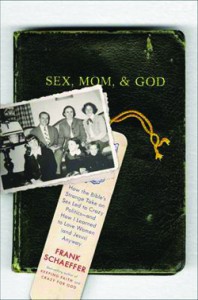
Frank Schaeffer is an apostate, and apostates can be a lot of fun. Individuals who are raised in a restrictive religious environment and later decide to reject it usually have interesting tales to tell. Schaeffer is no exception.
But Schaeffer has one other thing going for him: he’s a professional writer. This means his stories aren’t just interesting, they’re also well told. In his new book, Sex, Mom & God: How the Bible’s Strange Take on Sex Led to Crazy Politics—and How I Learned to Love Women (and Jesus) Anyway, Schaeffer serves up an intriguing combination that’s part sexual memoir and part exposé of religious right extremism. It’s a strange combination to be sure, but in the hands of a gifted wordsmith like Schaeffer it works.

For those who aren’t familiar with him, Schaeffer is the son of Francis Schaeffer, a highly influential evangelical theologian who played a pivotal role in the creation of the modern religious right.
In the 1970s, Francis Schaeffer penned a series of best-selling books on issues we would today recognize as manifestations of the “culture war.” His emphasis was on abortion, and he played a key role in getting evangelical Protestants involved in opposing Roe v. Wade, largely through his 1979 book Whatever Happened to the Human Race? (The tome, co-authored with C. Everett Koop, was later made into a successful film).
Frank Schaeffer followed in his father’s footsteps and for several years made his living thundering against liberals and secularists at religious right gatherings. But in the late 1980s, Schaeffer began to have doubts. In his 2007 book, Crazy for God, he recounted his decision to leave the religious right.
Sex, Mom & God focuses pretty much on what the title promises. Schaeffer’s mother, Edith, shared her husband’s conservative theology but wasn’t exactly prudish when it came to matters of sex. In fact, she may have been too frank in discussing the matter with her children. Schaeffer writes about his mother showing him her diaphragm when he was just eight years old; she also told him how often she and her husband had intercourse.
Indeed, Edith Schaeffer believed in a robust sex life—but only within the context of marriage. The family lived in a Christian mission in Switzerland called L’Abri, which was frequently visited by young pilgrims seeking enlightenment from the Schaeffers. Edith Schaeffer never hesitated to offer detailed advice to the young women who came through—right down to the type of nightgown they should buy for their wedding night.
But, as Frank Schaeffer writes, Edith’s views didn’t carry the day among many fundamentalists, who grew increasingly puritanical about sex. As Schaeffer writes, “Since the 1970s the American culture wars have revolved around a fear of Sex and women no less insane and destructive than any horror story to come out of Afghanistan. The issues of gay rights, abortion, premarital sex, virginity, abstinence, and the ‘God-given role’ of women (make babies, love Jesus, and shut up) have dominated our political/social debates. Why? Because sexual politics (American style) illustrates how deranged societies become when ideas about Sex are based on literal interpretations of biblical ‘accounts’ of the ‘facts’ of existence.”
As he surveys the cultural landscape bequeathed to us by the religious right, Schaeffer doesn’t hesitate to explore the role played by the lunatic fringe—activists who have had more influence than they should, considering their daft views. He speaks of Christian Reconstructionists who would base American law on the harsh legal code of the Old Testament. He tells of women raised in a movement called “Quiverfull,” some of whose adherents argue that girls shouldn’t even be educated because it just gets in the way of their main goal of producing large families. He talks of extreme Roman Catholic activists who are confident that papal decrees give them the right to meddle in the intimate affairs of others.
Alongside the analysis of the religious right is an unusually frank memoir of Schaeffer’s awakening sexuality. He writes about the flocks of “nubile” girls who flocked to L’Abri (and his reaction to them), his misguided attempt to engage in carnal acts with an ice sculpture at age ten, how he impregnated a young woman (now his wife) at age seventeen and even his attraction to other women, despite his happy marriage.
These portions of the book are revealing. If you’re bothered by a blunt discussion of sexual matters, this may not be the tome for you. But if you’re curious about how human sexuality is handled in many fundamentalist communities and why so many far-right Christians continue to obsess over this issue, Sex, Mom & God provides some answers.
After leaving the religious right, Schaeffer joined the Greek Orthodox Church. It’s clear he still grapples with theology. (For more on that, see his 2010 book, Patience with God.) But his search is an honest one. Schaeffer is not a humanist, but he’s forthright enough to embrace his doubts. Few believers these days have the courage to admit they even have them.
Humanists won’t agree with everything Schaeffer has to say in this book. I found his comments on abortion to be somewhat jumbled, but his reflections on gay rights were quite poignant—especially his discussion of a Washington, DC, press conference he took part in that was attended by a Ugandan gay rights activist who had to speak while wearing a paper bag to avoid being murdered later.
Frank Schaeffer has seen the religious right from the inside. Indeed, his father helped birth it. Humanists would do well to listen to him. As someone who knows the movement well, Schaeffer also understands its weaknesses. That’s critical information for those of us working to stop the theocrats who yearn to control not just our sex lives but indeed all aspects of our existence.