
The Bible According to Thomas Jefferson
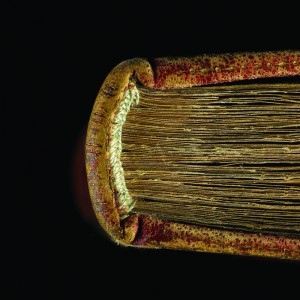 Hugh Talman, Smithsonian’s National Museum of American History
 Editor’s note: in honor of Thomas Jefferson’s 271st birthday on April 13, TheHumanist.com looks back at two articles from the March/April 2012 issue of the Humanist magazine. Read Peter Carlson’s examination of Jefferson’s Bible below, and click here to read “Jefferson’s Women” by Cleo Fellers Kocol.
The president sat at his desk in the White House on a winter evening. He’d finished his work for the day and was ready for something more enjoyable. He took out two Bibles and opened them to the story of Jesus. Then he grabbed a knife—or perhaps a razor—and began cutting up one Bible, then the other. The president was Thomas Jefferson. The year was 1804.
Working methodically, Jefferson sliced out the parts of the Bible that he believed and pasted them onto a folio of blank pages. The rest—the parts he didn’t believe—he left behind in two maimed, mutilated Bibles.
Thomas Jefferson was editing the Bible, a book regarded by most of his fellow Americans as the word of God. The act was certainly presumptuous, perhaps blasphemous. But Jefferson found the task simple. The worthy parts of the Bible were easily distinguishable from the worthless—“as distinguishable,” he later wrote in a letter to John Adams, “as diamonds in a dunghill.”
Using the passages he sliced out of his Bibles, Jefferson created a new book, which he called, “The Philosophy of Jesus of Nazareth.” He had it bound but he never published it, and he told only a handful of close friends about it. His copy—the only copy that ever existed—later disappeared and is now lost to history.
But sixteen years later, he created another. In 1820, retired from politics and living at Monticello, Jefferson sat down again, at the age of seventy-seven, to edit the Bible. He purchased six Bibles—two in English, two in French, and two containing both Latin and Greek—and cut them up, creating a second edited version of the New Testament, in four languages.
In this book, he kept the words of Jesus and some of his deeds, but left out the miracles and any suggestion that Jesus is God. The virgin birth is gone. So is Jesus walking on water, multiplying the loaves and fishes, and raising Lazarus from the dead. Jefferson’s version ends with Jesus’ burial on Good Friday. There is no resurrection, no Easter Sunday. Jefferson called this version “The Life and Morals of Jesus of Nazareth.”
That book has survived. It’s smaller than you might expect—roughly five by eight inches—with a faded red leather cover. Conservators at the Smithsonian’s Museum of American History in Washington, DC, painstakingly repaired rips and restored the book. It’s currently on display at the museum, along with two of the Bibles that Jefferson cut up to create it.
The exhibition is sure to generate questions: Why did one of America’s beloved Founding Fathers cut up Bibles? Was it an act of piety or of blasphemy? Was Jefferson a Christian or a heretic? And what does this book, commonly known as the “Jefferson Bible,” tell us about America’s religious heritage?
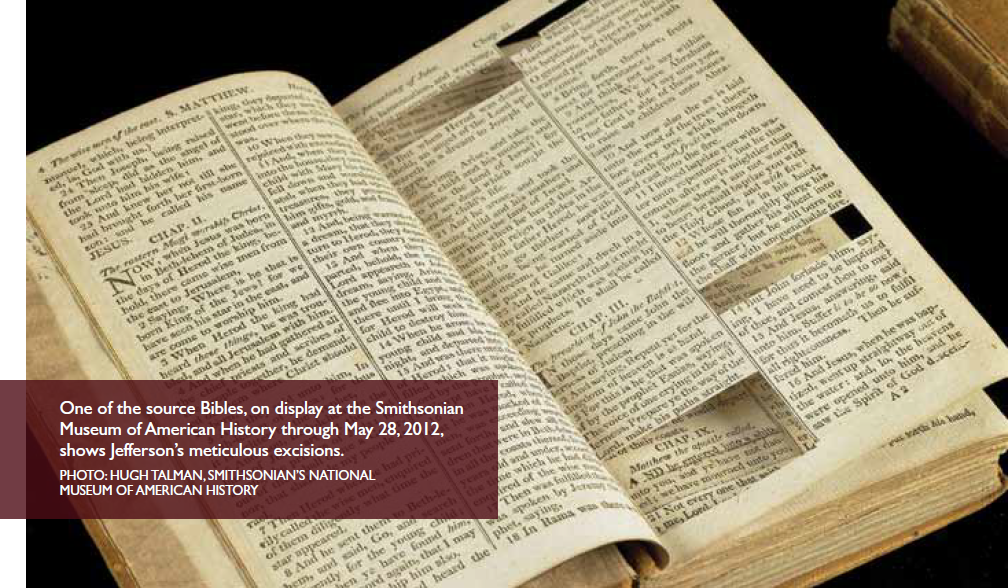
Those questions have no easy answers. Experts argue about all of them, as we shall see. But one thing seems certain: If Jefferson was running for president today, his Bible-slicing experiments would surely torpedo his candidacy.
“There is no way Jefferson could get elected president today,” says Steven Waldman, author of Founding Faith, a best-selling history of the role of religion in America’s creation. “You can practically see the attack ad that would be run about him: You see the Bible and you see a hand with a scissors cutting up the Bible. And that’s not going to play too well in the red states—or the blue states for that matter.”
“I am a sect by myself,” Thomas Jefferson once wrote, commenting on his eccentric religious views. Born into the Church of England, Virginia’s official religion, Jefferson studied under Anglican clergymen from elementary school through college, and attended Anglican services all his life, although not always faithfully. He wasn’t the kind of man who accepts dogmas uncritically. Brilliant and intellectually curious, Jefferson preferred to make his own judgment in matters of religion, and advised others to do the same.
“Question with boldness even the existence of a God,” he urged his nephew, Peter Carr, in 1787, “because, if there be one, he must more approve the homage of reason, than that of blindfolded fear.”
Influenced by the intellectuals of the Enlightenment, Jefferson scoffed at biblical stories of miracles but believed that the study of nature proves the existence of God. He thought deeply about religion all his life, and although his views sometimes shifted, one opinion never changed: He believed that no government had the right to impose any religion on any individual. He wrote Virginia’s statute on religious freedom and famously coined the phrase “wall of separation between church and state.”
“The legitimate powers of government extend to such acts only as are injurious to others,” he wrote in his Notes on the State of Virginia. “But it does me no injury for my neighbor to say there are twenty gods or no god. It neither picks my pocket nor breaks my leg.”
Today, that statement seems uncontroversial but in 1800, many people, particularly clergymen, considered it evidence of atheism. “They were of the opinion that not caring about that meant you were not a man of faith,” says Joseph J. Ellis, author of American Sphinx, a best-selling biography of Jefferson.
When Jefferson ran for president against John Adams in 1800, Adams’ Federalist allies distorted Jefferson’s defense of freedom of religion to portray him as an enemy of God. Alexander Hamilton called Jefferson “an Atheist in Religion and a Fanatic in politics.” William Linn, a New York minister, claimed that voting for him constituted “a rebellion against God.” Yale President Timothy Dwight warned Americans that if they elected Jefferson they would “see the Bible cast into a bonfire…and our children united in chanting mockeries against God.”
Despite all that, Jefferson won the election.
But the various lies about his religious beliefs angered him and hardened his antipathy to the clergy, who he described in Latin as “genus irritable vatum”—irritable tribe of priests—and in English as “soothsayers and necromancers.”
The nasty campaign of 1800 rendered Jefferson reticent about making public statements on religion. But he remained fascinated with the topic and continued to comment on religion in letters to trusted friends. Those comments are so voluminous and so varied that, for two centuries, both Christians and secularists have cherry-picked Jefferson quotes to “prove” that the sage of Monticello was a believer—or not.
Want to prove that Jefferson was a committed Christian? It’s easy.
Jefferson wrote, “I am a real Christian, that is to say a disciple of the doctrines of Jesus.” He called Christ’s teachings “the most sublime and benevolent code of morals which has ever been offered to man.” He urged “getting back to the plain and unsophisticated precepts of Christ.” He suggested that the defeat of Napoleon “proves that we have a god in heaven.” In his first inaugural address, he invoked the blessings of “that Infinite Power which rules the destinies of the universe.” In his second inaugural address, he sought the blessings “of that Being in whose hands we are, who led our forefathers, as Israel of old, from their native land and planted them in a country flowing with all the necessaries and comforts of life.”
Want to prove that Jefferson was a militant secularist? That’s easy, too.
Jefferson wrote that “Jesus did not mean to impose himself on mankind as the son of God.” He called the writers of the New Testament “ignorant, unlettered men” who produced “superstitions, fanaticisms, and fabrications.” He called the Apostle Paul the “first corrupter of the doctrines of Jesus.” He dismissed the concept of the Trinity as “mere Abracadabra of the mountebanks calling themselves the priests of Jesus.” He believed that the clergy used religion as a “mere contrivance to filch wealth and power to themselves” and that “in every country and in every age, the priest has been hostile to liberty.” And he wrote in a letter to John Adams that “the day will come when the mystical generation of Jesus, by the supreme being as his father in the womb of a virgin, will be classed with the fable of the generation of Minerva in the brain of Jupiter.”
So which Jefferson was the real Jefferson—the serious Christian or the angry heretic?
Both, says Waldman. Jefferson’s beliefs don’t conform to the “stereotypes created by modern culture warriors,” Waldman wrote. “He was anti-Christian and pro-Jesus. He was anti-religion and pro-God. He was against blind faith and in favor of reason-based belief. He resented being considered a heretic because he believed that his approach to God and Jesus was more faithful to both of them.”
On January 29, 1804, Jefferson wrote to his friend Joseph Priestley, the British scientist and dissident theologian, suggesting that Priestley compile a book of Jesus’ “moral doctrines,” extracted from the Bible.
“It would be,” Jefferson said, “short and precious.”
Priestley died a week later, so Jefferson did the job himself, spending a couple nights at the White House, cutting and pasting. He titled it “The Philosophy of Jesus of Nazareth” and identified it as “an abridgment of the New Testament for the use of the Indians.”
That last phrase has since kicked up a controversy. Some Christian historians note that Jefferson had earlier signed a law appropriating federal money to subsidize missionary work among the Native Americans, and they suggest that perhaps Jefferson’s first cut-and-paste Bible was designed to serve as a sort of Reader’s Digest Bible condensed for American Indians. Other historians disagree, noting that Jefferson never attempted to use his Bible to educate Indians, never mentioned that idea in his letters, and later wrote to John Adams, saying that he created the book “for my own use.”
Who’s right? Nobody really knows.
In 1816, seven years after he left the White House, Jefferson wrote to a friend, discussing his edited Bible, and adding this thought: “It was too hastily done, however, being the work of one or two evenings only while I lived at Washington, overwhelmed by other business, and it is my intention to go over it again at more leisure.”
Sometime in late 1819 or early 1820, Jefferson finally found the time to do exactly that. He purchased Bibles in Greek, Latin, French, and English and, working very meticulously, cut them up, extracting the passages he wanted and carefully pasting them in four vertical columns, two columns to a page. He added two maps of the Holy Land, and sent his eighty-six pages to Frederick Mayo, a Richmond bookbinder, who bound them in an elegant red leather cover.
When Jefferson finished the project, he wrote to his friend William Short, explaining that he had edited the Bible in order to separate the sublime from the ridiculous. “I find many passages of fine imagination, correct morality, and of the most lovely benevolence; and others again of so much ignorance, so much absurdity, so much untruth, charlatanism, and imposture, as to pronounce it impossible that such contradictions should have proceeded from the same being.” It wasn’t difficult to tell the “lovely benevolence” from the “absurdity,” he added: “I found the work obvious and easy.”
Pleased with both versions of his cut-and-paste Bible, Jefferson later wrote to a friend that he was “in the habit of reading nightly from them before going to bed.”
After Jefferson died in 1826, the first of his Bibles disappeared, but the second remained in his family. In 1895 Cyrus Adler, a librarian at the Smithsonian, purchased the book from Jefferson’s great-granddaughter for $400. When the Jefferson Bible was exhibited, it caught the eye of Rep. John F. Lacey, an Iowa Republican. In 1902 Lacey proposed that Congress appropriate $3,227 to print 9,000 copies—3,000 copies for the Senate and 6,000 for the House. The bill passed, despite opposition from ministers angry that the government would print a “Bible” with the miracles removed, along with any suggestion that Jesus might be God.
“The preachers generally oppose the publication,” reported the Richmond Dispatch, “and so do the publishers, the latter wanting the job for themselves.”
House members quickly gave their copies of the book to constituents, but the Senate saved enough of them to provide a volume to each incoming freshman senator for the next fifty years. In 1957 Frank Church, a newly elected senator from Idaho, took the oath of office and was presented with a copy of Jefferson’s Bible. Two years later, he gave it to his son, Forrest Church, who eventually became a prominent Unitarian Universalist minister and the editor of an edition of the Jefferson Bible.
Over the last century, countless editions of the book were published, many containing introductions that attempt to prove that Jefferson held the same religious views as whoever was writing the introduction—Jefferson as Unitarian, as evangelical, as agnostic.
In 1996 Judd W. Patton, a professor of economics at Bellevue University in Nebraska—aided by the Nebraska Christian Coalition—published an edition that he distributes to every incoming member of Congress. If those politicians take the time to study Jefferson’s book, Patton wrote in his introduction, they might “begin the process of restoring and reclaiming our moral bearings and moral heritage.”
In 2009 Cari Haus, an accountant and Christian author, published The Reverse Jefferson Bible, which contains the parts left out of Jefferson’s version. “Unfortunately, Jefferson missed the point that the morals of Jesus were linked to the Way, the Truth and the Life,” she wrote in her introduction. She also issued a “warning” to Jefferson in the form of a quotation from the Book of Revelation: “And if any man shall take away from the words of the book of this prophesy, God shall take away his part out of the book of life.” Haus did not quote Jefferson’s 1825 description of the Book of Revelation: “merely the ravings of a maniac.”
Meanwhile, the vast army of Jefferson biographers, as well as religious scholars of various views, continue to debate the meaning of Jefferson’s Bible and our third president’s spiritual musings and proclivities.
“Doctrinally, he’s a heretic,” says Waldman. “He doesn’t believe in Jesus’ divinity or the miracles or many of the central tenets of orthodox Christianity. And yet, when you read Jefferson’s Bible you come away with the sense that he is quite religious in his own way, quite spiritual in his own way.”
“In Jefferson, there’s a lack—I really think it’s a learning disability—a lack of understanding about spirituality,” says Garrett Ward Sheldon, a professor of political science at the University of Virginia and author of The Political Philosophy of Thomas Jefferson. “He was a brilliant man but he was very practical, very scientific. He just didn’t get spirituality.”
“Jefferson was a deist,” says Ellis. “He believed God created the world but doesn’t have much to do with it any more.”
“Jefferson was not a true deist,” says Waldman. “Jefferson believed in a God who intervened in the course of history.”
Sheldon, who is a Baptist minister as well as a political scientist, is amused that Jefferson cut up the Bible. “Madison wrote commentary on the Bible. Jefferson edited it,” he says, laughing. “As a God-fearing Christian, I find it presumptuous to edit the Bible. But to him, it wasn’t.”
Actually, almost everybody edits the Bible, says Lori Anne Ferrell, author of The Bible and the People and a professor of history and literature at Claremont Graduate University. “Even people who read the Bible regularly only read parts of it. People read selectively. They read the parts they believe or the parts that give them comfort. For most people, the Bible is a cut-and-paste job. It’s just that Jefferson actually takes a scissors or a knife and actually excises the parts he doesn’t think should be in there.”
“Jefferson did this in a somewhat audacious way, but I think it’s also respectful,” says Harry Rubenstein, the Smithsonian curator who worked on the Bible. “He’s not trashing Jesus. He’s writing to his colleagues saying this is the greatest moral teacher of all time, and these moral principles can be the basis for the new republic.”
Arguments over Jefferson’s religious views have been going on since the presidential campaign of 1800, and they are unlikely to end any time soon for one simple reason: Americans care deeply about religion, and about Jefferson.
“The battle over Jefferson’s religious legacy is kind of crazy,” says Ellis. “But Thomas Jefferson is a powerful trophy. Having Jefferson on your side is a big thing. And having him on the other side is bad news.”
Waldman agrees, but he doesn’t believe Jefferson truly belongs on either side of current cultural debates.
“Looking at the Jefferson Bible should teach people on all sides of the debate to be very skeptical when someone of their tribe quotes a Founding Father to prove that he was an ally in their cause,” Waldman says. “It’s easy to cherry-pick the Founding Fathers’ quotes to ‘prove’ that they were either orthodox Christians or they were secular. They were neither. Their religious views were complex and fascinating and they don’t lend themselves to being pigeonholed or used in the modern culture wars. When you do that, you distort reality.”
SIDEBAR: Resurrecting Jefferson’s Bible
Article and sidebar reprinted with permission, American History, October 2011, copyright Weider History Group.