
Prohibition & Humanism

Share |


“Pot’s Legal!” declared the Seattle Times in large print on November 7, 2012, while that same day the Denver Post ran the headline: “FIRED UP.” As two states have legalized the recreational use of marijuana, an ancient debate is slowly rekindling. The term prohibition seems to be a remnant of an age long past, when mobsters wearing slick suits and fedoras sipped moonshine in speakeasies. However, as marijuana legalization enters onto the national stage, the word is quickly becoming associated with a new intoxicant. The religious and non-religious alike find themselves once again faced with a moral question that has haunted humanity since the first caveman stumbled across fermenting fruit: Should drugs be allowed?

For as long as drugs and alcohol have existed, society and religion have weighed judgment on their consumption. In ancient Egypt beer was a gift from Osiris, while in ancient Greece many praises were sung to Dionysus, god of the grape harvest and life of the party. However, many of the world’s younger religions have not been so friendly toward intoxicants. Buddhists, Muslims, and Mormons generally condemn drugs and alcohol as a form of evil, while Christians can’t seem to agree on whether intoxicants are a gift from God or a tool of Satan.

Christianity’s indecision on drug and alcohol policy is directly related to a number of contradictions in the Bible. In the beginning, it seems as if God tacitly accepts the consumption of booze. In Genesis, God’s right-hand man on earth, Noah, loves the stuff. Following the flood, he immediately plants a vineyard and lolls about naked and drunk once his wine has fermented (Genesis 9:20-25). As humanity repopulates, God’s people continue to sing praises for this apparent gift to man. The Song of Solomon contains beautiful poetry comparing the joys of love to the intoxication of wine (Song of Solomon 1:2, 7:9). Later, when the wine runs out at a wedding, God’s own son goes on a celestial booze-run, reinvigorating the party (John 2:1-11). Given that precedent, one would think that Christians would host keggers every Sunday. However, as Alcoholics Anonymous will tell you, there are many other Bible verses that simultaneously condemn the consumption of intoxicating beverages.

To a nontheist, it seems rather silly to try and divine whether an all-powerful God smiles or frowns when you take a shot of tequila. However, in societies all around the world, religious lawmakers continue to ask that very same question, enacting strict prohibitionist measures as a result. As self-envisioned servants of God, they feel their duty is to bring divine law to his jurisdiction. With religion as their hammer and the law as their chisel, governments the world over actively persecute those nonbelievers who hold their own codes of morality when it comes to inebriating substances.

In the Islamic world, many drug and alcohol laws come straight out of the Koran, which teaches that khamer, or intoxicants, are instruments of Satan. In Saudi Arabia, getting caught with a beer comes with a punishment of forty lashes; a rather mild sentence when one considers that in much of Southeast Asia, drug possession often merits the death penalty. As the prophet Mohammed said, “Whosoever drinks wine, whip him. If he repeats it for the fourth time, kill him.”

The United States saw its fair share of religiously motivated moral legislation in the early twentieth century, when Evangelical Protestant churches and religious fundamentalists pushed for the prohibition of alcohol, intent on removing this “evil” from society. The Rev. Mark Matthews, a leading figure in the temperance movement, famously noted, “The saloon is the most fiendish, corrupt, hell-soaked institution that ever crawled out of the slime of the eternal pit. …It takes your sweet innocent daughter, robs her of her virtue, and transforms her into a brazen, wanton harlot. …It is the open sore of this land.” With the ensuing ratification of the Eighteenth Amendment in 1919, religious conservatives believed that God’s will had been done, and that the United States had succeeded in taking a bold step towards achieving heaven on earth.

However, to their dismay, after the law took effect in 1920 people kept on drinking, and the United States was soon facing a rampant problem with organized crime. The “noble experiment,” as it came to be known, ended in 1933 with the passing of the Twenty-first Amendment, and the power to regulate alcoholic beverages was passed back to the states. Today, many of these religiously fueled state laws remain unchanged in rural America. “Dry Counties” are a common occurrence in the South, and all across the United States unusually harsh punishments abound for underage drinking, public intoxication, and other nonviolent alcohol-related offenses.

There are those Americans who view the so-called “war on drugs” as Christianity’s most recent attempt to push moral prohibitionism on the masses. Sam Harris, author of The End of Faith, for example, calls it a “war on sin,” noting that the organizational factor behind current U.S. drug policy is to simply outlaw “anything which might radically eclipse prayer or procreative sexuality as a source of pleasure.” The bottom line, Harris argues, is that intoxicants are perceived by religion as a threat to individual faith.

This begs the question, does current drug policy truly serve the objective betterment of society, or has it been pointedly enacted by religious zealots attempting to push their interpretations of sacred text on the masses? A 2010 Pew Research Center poll found that while 64 percent of the religiously unaffiliated believed marijuana should be legalized, only 33 percent of Christians shared that view. Indeed, it is religious interest groups that have been the driving force behind anti-drug policies in the United States. The two largest Christian lobbying groups, the U.S. Conference of Catholic Bishops and the Family Research Council, are major funding sources for anti-legalization efforts. Just as the temperance and prohibition movements of the early twentieth century were largely fueled by religious fervor, it is reasonable to conclude that the modern war on drugs is in large part fueled by Christian moral interests.

The legislation of morality is widespread; from blasphemy to gay inequality to reproductive rights, religious majorities actively persecute those with differing values through the codification of morality. And while many of these marginalized groups have seen notable public support, the public is largely silent when it comes to the marginalization of those who choose to use drugs. Just as religion often labels those with alternative sexual preferences as morally corrupt or evil, so too does religion judge those who choose to use drugs and alcohol as morally inferior.

Part of the philosophy of humanism is to stand against outdated codes of morality that persecute and make life difficult for people. Just as LGBT issues are humanist issues, so too are drug and alcohol issues. When evaluating how society treats inebriants, science and reason should be the standards by which we create policy, not ancient religious texts. Most comparative policy studies agree that drug and alcohol abuse should be regarded as a public health issue, as opposed to a criminal justice issue, and that public funds are best spent on drug treatment and prevention rather than enforcement and incarceration.

Predominant theocratic norms have so influenced society that tacit acquiescence for religious prejudice has largely replaced critical analysis when it comes to social attitudes towards drug use. Indeed, there is little opposition, even among nontheists, to laws that persecute those who choose to use drugs. However, humanism and human decency afford that individuals with varying values and beliefs should be respected, not shunned.

One example of a largely unopposed, overly harsh drug law in the United States is the Higher Education Act’s Aid Elimination Penalty, which states that any individual with a misdemeanor drug offense is to be barred from receiving federal financial aid to attend college. Because of the provision, hundreds of thousands of promising students have been forced to drop out of college because of minor, nonviolent drug offenses. The penalty was introduced in 1998 by Rep. Mark Souder (R-IN), a Christian conservative whose battles included anti-abortion legislation and the prohibition of online gambling. Heavily influenced by his religion, when asked about his position on abortion, Souder responded, “the closer to the clearness of the Bible, the less ability I should have to compromise.” Ironically, this moral crusader left office in 2010 after admitting to an affair with a staffer, lamenting in his resignation speech that he had “sinned against God.”
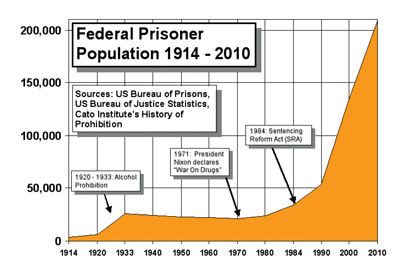
While drug laws that prevent access to education have untold social costs, the financial burdens of the war on sin can be more easily calculated. In 2010 alone, the Office of National Drug Control Policy estimates that this so-called war cost the U.S. federal government $15 billion, and state governments another $25 billion. Incarceration costs alone can be staggering. In 2011 the State of California spent $45,006 per inmate and approximately 31 percent of all California inmates were booked on drug offenses. To put that into perspective, the state spent $8,667 per college student in the same year. Because of the war on drugs’ mandatory minimum sentencing laws, Americans now comprise 4.4 percent of the world’s population, but 23.4 percent of its prison population.

The Obama administration has at least vocalized concerns regarding the failure of national drug policy. As stated in its recently released 2012 National Drug Control Strategy: “science has shown that drug addiction is not a moral failing but rather a disease of the brain that can be prevented and treated.” However, upon review of the actual policy, many have concluded that the only thing changed is the wording. “This strategy is nearly identical to previous national drug strategies,” stated Bill Piper, the director for national affairs at the Drug Policy Alliance. “While the rhetoric is new, reflecting the fact that three-quarters of Americans consider the drug war a failure, the substance of the actual policies is the same.” Green Party presidential candidate Dr. Jill Stein raised similar concerns, noting that “President Obama promised to use a science-based approach to public policy. But when it comes to marijuana, he has continued the unscientific policies of George Bush, and has even gone far beyond Bush in his attacks upon medical marijuana clinics.”

Eighty-some years ago, the primary motivations for ending the alcohol prohibition were the staggering economic costs of enforcement, as well as the huge impact of lost tax revenues. A 1929 pamphlet distributed by the Association Against the Prohibition Amendment estimated that the total loss of federal tax revenues was $861 million, the equivalent of $108 billion dollars today. The nation, in the midst of the Great Depression, was in desperate need of these tax revenues to implement economic stimulus programs, and so in 1932 a bipartisan effort saw the passing of the Twenty-first Amendment. Perhaps a similar appeal to reason can be made in our current time of financial uncertainty. If nothing else, perhaps religious lawmakers can be made to see that their war on sin has failed in economic terms.

Ideally, a majority of lawmakers may eventually come to realize that drug experimentation is a natural human phenomenon—that humans are instinctively attracted to mind-altering substances.

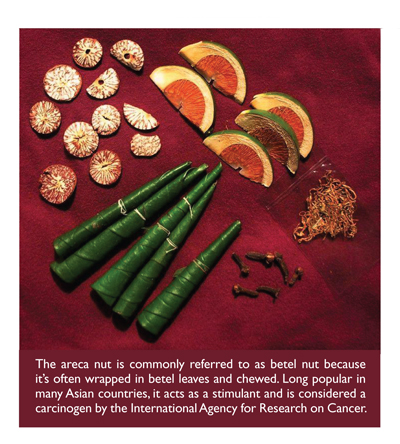
Archaeologists have uncovered widespread evidence of drug consumption in ancient communities across the globe. The oldest evidence of beer consumption dates back to around 5000 BCE in what is now Iran, while wine consumption goes back even further, to about 6000 BCE. The consumption of betel nut, the fourth-most used drug in the world after nicotine, alcohol, and caffeine, dates back 13,000 years ago in Timor, and 10,700 years ago in Thailand. Coca was domesticated in the western Andes close to 7,000 years ago, and the consumption of tobacco in the Americas, pituri in Australia, and khat in Eastern Africa already represented ancient practices when European colonists made first contact, perhaps dating back 40,000 years or more. Most anthropologists agree that human drug consumption predates human civilization.
Indeed, neurological studies have revealed that drug use has been a part of mammalian societies since ancient times. According to a study from the Stanford University School of Medicine, the central nervous system has developed certain receptors that indicate co-evolutionary activity between mammalian brains and psychotropic plants. In essence, the human brain has “evolved receptor systems for plant substances, such as the opioid receptor system, not available by the mammalian body itself.” The study notes that a common ancestor evolved these receptors at some point in evolutionary history in order to accommodate substance consumption. The study also points towards the body’s natural defenses against drug overdose, such as exogenous substance metabolism and vomiting reflexes, as further evidence for mammalian coevolution with psychotropic plants. As odd as it might seem, this suggests that humans are actually hardwired to enjoy drug consumption.

While coevolution explains why humans can experience drugs, it doesn’t explain why humans choose to use drugs despite social stigma against them. Another theory of human drug consumption explores the idea of modern drug experimentation as a form of evolutionarily novel behavior. The theory builds off of what evolutionary psychologist Satoshi Kanazawa calls the Savanna-IQ Interaction Hypothesis. It combines his Savanna Principle, which states that the human brain has difficulty dealing with entities and situations that didn’t exist in the ancestral environment, with the theory of evolution of general intelligence, which suggests that general intelligence evolved as a psychological adaptation to solve evolutionarily novel problems. Within the realm of evolutionary psychology, this hypothesis predicts that individuals of higher intelligence are more likely to engage in novel behavior that goes against cultural traditions or social norms.

Interestingly, the findings of a forty-year-long study funded by the British government paralleled this hypothesis, and found that “very bright” individuals with IQs above 125 were about twice as likely to have tried psychoactive drugs than “very dull” individuals with IQs below 75. As Kanazawa explains, “Intelligent people don’t always do the ‘right’ thing, only the evolutionarily novel thing.” Other forms of evolutionarily novel behavior that are more prevalent among individuals with higher IQs include vegetarianism and the use of contraceptives. Kanazawa, who is a senior scholar at the London School of Economics, even suggests that liberalism and atheism can fall under the Savanna-IQ Interaction Hypothesis as a form of evolutionarily novel behavior defying the deeply ingrained cultural traditions of humanity.

But whether humans choose to use drugs simply because they are hardwired for it, or because evolution inclines them towards experimentation, it is important to push for the continuation of research into the science behind intoxicating substances in order to better understand the relationship between psychotropic drugs and human beings. Further research into the spiritual effects of many recreational drugs may even lead to a deeper understanding of human spirituality and religion. Unfortunately, as with stem-cell research, religious lawmakers within the U.S. government continue to obstruct research involving recreational drugs in the name of morality.

The government’s primary tool in enforcing modern drug prohibition and monitoring drug research is the Controlled Substances Act (CSA) of 1970. By means of the CSA, the federal government has the final say in the legal status of any and all drugs. Under the CSA, drugs are classified into different groups, schedules I-V, which represent the relative risk each drug poses to society. Schedule-I drugs are generally regarded as the most dangerous, and are classified by the following criteria:

The drug or other substance has a high potential for abuse.
The drug or other substance has no currently accepted medical use in treatment in the United States.
There is a lack of accepted safety for use of the drug or other substance under medical supervision.

Marijuana still remains on the Schedule-I list despite countless studies showing it to be non-addictive, safe for personal consumption, and to have valuable medicinal properties. Other drugs currently labeled as Schedule-I have also shown promising medical value even though their recreational use can be dangerous. MDMA (the primary ingredient in “ecstasy”) has been proven to be an effective means of treating Post-Traumatic Stress Disorder. LSD (“acid”) and psilocybin (or psychedelic mushrooms) have shown potential for use in the treatment of certain psychiatric ailments. Ibogaine (a hallucinogen with psychedelic and dissociative properties) has been proven to cure heroin addiction, and GHB (gamma hydroxybutyrate, a recreational depressant also used as a date-rape drug) is commonly used outside of the United States in the treatment of narcolepsy.

If science is to be the ideal standard by which policy decisions should be made, more research into the true nature of psychotropic substances is needed. It’s simply counterproductive to mislabel substances in order to stifle research and stiffen penalties. Moreover, to weigh moral judgment on the mere existence of recreational drugs is to presuppose a cosmic struggle between good and evil. As Lewis Lapham writes in the Winter 2013 issue of Lapham’s Quarterly (devoted to the theme of “Intoxication”), the war on drugs is essentially a war on human nature, and that whether declared by church or state, such a war is “by definition lost.” However, as it’s waged, this war against human nature strengthens the fear of one’s fellow humans. “The red, white, and blue pills sell the hope of heaven made with artificial sweeteners,” Lapham opines.

For now, all eyes are on Washington and Colorado. How will their noble experiment fare? Will it result in increased crime rates and social discord? Will pot stores be fiendish, hell-soaked open sores on the land? Or will the law create a safe and legal way to access a friendly substance that makes people feel good? If the latter proves true, it may be necessary to reevaluate how society regards all recreational drug use.

Popularity should not be the standard by which the legality of recreational drugs is decided. Scientists and policymakers alike need to review current motivations behind drug policies. It’s important to recognize that whether it’s drinking coffee in Seattle, smoking hookah in Istanbul, sipping sake in Tokyo, or eating ibogaine in the jungles of Cameroon, drug use is something that is deeply ingrained in the cultural traditions of humanity. Religion tends to breed fear and contempt towards all that it would interpret as evil, be it homosexuality, stem-cell research, or drug consumption. Humanism should challenge that norm, encouraging tolerance and understanding while fighting against religiously motivated bigotry and the moral legislation that goes along with it.

Brett Aho is a freelance writer currently based in Seattle, Washington and a recent Fulbright scholar who holds degrees in French, German, and international relations from the University of Redlands. More of his work can be found at BrettAho.com.


Share |


  • jayTow22

    “Part of the philosophy of humanism is to stand against outdated codes of morality that persecute and make life difficult for people.” I agree.

    BUT, to say that opposing the legalization of drugs is an outdated code of morality is bias. Religious laws (adapted), legislated laws (amended), and social (unwritten and changing) laws all reflect who we are as a society and what we deem to be acceptable. It’s wrong to propose that, if you’re against the legalization of drugs, you’re somehow anti-humanist and outdated in your thinking. There are strong arguments on both sides, for and against the legalization of drugs. Clearly the author is presenting and supporting one side of the argument. At the end of the day, there is no perfect solution. So, we are faced with a choice – a preference – for how we want to live and our society to proceed.

    • drumsareus

      Even though there is no perfect solution, there are solutions which are objectively better than others. An example is that needle exchange programs prevent needle born illness from spreading in the drug user community. Some members of our society would still rather ban needle exchange programs for whatever reason. They think that making drugs illegal will somehow prevent people from using. Clearly this is not the case.

      • jayTow22

        Addictions can devastating to people, and disease is a part of that. Needle exchange programs are meant to help prevent the spread of disease. However, they are not a solution.

        The truth is, we don’t know if the legalization of drugs will resolve any problems. While legalizing drugs may hit the black market where it hurts, the black market will survive. It will either turn to hard drugs, undercut the cost of government regulated drugs, or find a new source of revenue.

        But, never mind the black market, what are the repercussions of legalizing drugs to the average citizen? Do we really need to make more addictive substances mainstream? Many illegal drugs are not harmless substances—they have serious negative consequences for the health of users and addictive liability, which will not change with their legalization.

        (The legalization of tobacco and alcohol should not be used as a shining example of a system working, when they are responsible for 500,000 premature deaths each year.)

        As well, where do ethics fit in, if drugs are legalized? If your government is saying that it’s OK to use drugs, how to do you tell your child otherwise?

        The Netherlands was once hailed as a country successful in legalizing drugs; however, new reports indicate otherwise. It should also be noted that the country only legalized “soft drugs”.

        Here’s a bit of cut and paste from Wikipedia:

        The drug policy of the Netherlands officially has four major objectives:
        - To prevent recreational drug use and to treat and rehabilitate recreational drug users.
        - To reduce harm to users.
        - To diminish public nuisance by drug users (the disturbance of public order and safety
        in the neighbourhood).
        - To combat the production and trafficking of recreational drugs.

        A government committee delivered in June 2011 a report about Cannabis
        to the Dutch government. It includes a proposal that cannabis with more
        than 15 percent THC should be labeled as hard drugs. Higher
        concentrations of THC and drug tourism have challenged the current
        policy and led to a re-examination of the current approach; for e.g. ban
        of all sales of cannabis to tourists in coffee shops…

        • drumsareus

          Thanks for your comment. There are a few things you say I’d like to refute.

          >>While legalizing drugs may hit the black market where it hurts, the
          black market will survive. It will either turn to hard drugs, undercut
          the cost of government regulated drugs, or find a new source of revenue.

          The black market won’t be able to undercut the cost of legal production of drugs unless the taxes put on these drugs are exorbitantly high. Also the black market cannot turn to hard drugs if ALL drugs are made legal (in a regulated fashion). I also hear the ‘They will find a new source of revenue’ argument a lot, but what other sources are there? In a society where drugs, gambling, and prostitution are legal, just about the only thing there would be a black market for is underage prostitutes.

          >>But, never mind the black market, what are the repercussions of
          legalizing drugs to the average citizen? Do we really need to make more
          addictive substances mainstream? Many illegal drugs are not harmless
          substances—they have serious negative consequences for the health of
          users and addictive liability, which will not change with their
          legalization.

          I would hope that very harmful drugs like Meth and Heroin would not become mainstream with legalization. The way I envision it is there would be places where users can go and administer drugs on site. These drugs would be provided at a very low cost to prevent users from committed crimes to afford them. I believe the cost of providing unadulterated drugs to a user is less than that of of gang violence over drug sales and theft to support addition.

          >> As well, where do ethics fit in, if drugs are legalized? If your
          government is saying that it’s OK to use drugs, how to do you tell your
          child otherwise?

          The govt says that it’s okay to use alcohol and tobacco and parents and schools teach their children these things are for adults. I see no reason why drugs would be different.

          • jayTow22

            It would be an interesting social experiment to be sure, but I’m not sure it’s worth the risk.

            >>I think it would be easy for the black market to undercut the cost of regulated drugs. The regulation, distribution, and enforcement of that regulation costs money… taxpayer money.

            >>The black market is elbows deep in illegal prostitution and gambling rings.

            >>Methadone clinics have existed (e.g. Vancouver), but they don’t have a high success rate. (I’m not sure why.) As well, they also cost taxpayer money.

            >>Again, alcohol and tobacco should not be used as shining examples.

            On a personal note, I hate being bombarded with the stench of cigarette smoke. The smell of marijuana is just as bad, if not worse. As well, it bothers me when people get completely inebriated, to the point where I can’t have a normal conversation with them. I worry that, by introducing other drugs into the mainstream, that will only increase. Blah!

          • chocltlabs

            It’s called tolerance that allows us to accept people who are different than us, and I think if we drop our delicate sensibilities about “smells,” we’ll find people beneath them who are equally deserving of respect and kindness. I, too, don’t care for the smell of cigarette smoke, but I like hanging out with people who smoke because they tend to be more genuine, unassuming and unpretentious than those who don’t.

          • jayTow22

            People who smoke are more genuine, unassuming and unpretentious? People who don’t like the smell of cigarette smoke have “delicate sensibilities”? Really? You’ve managed to insult a large group of people with your condescending comment. Not liking cigarette smoke has nothing to do with not liking those who smoke. Don’t confuse the two.

          • chocltlabs

            Well, non-smokers insult smokers on a regular basis just for smoking, so let’s look at the pots calling the kettles black. I’ve seen it. I hear about it with smokers in tears over the abuse they endure. So if I’ve managed to insult a large group of people, think what THEY do to smokers who don’t deserve being treated like second class citizens everywhere they go.

  • http://www.facebook.com/profile.php?id=1258483682 Bob Hazy

    It’s ironic that much of this argument relies upon a “Humanist Morality” to attack religious morality. Humanists disdain this type of argument as it’s as weak as the regime it opposes. The compelling part of this article is the pragmatic article that drug policy doesn’t work and is absurdly expensive. One avenue left unexplored is how pursuit of such policy drives an illicit economy that wouldn’t exist otherwise. Collaterally, associated violence escalates with the value of the illicit trade.

    Humanists should refrain from relativistic moral arguments. The ultimate humanism is to avoid this weakness entirely in favor of clear-headed pragmatism.

    • northernTNT

      Most Humanists are moralists at heart, coming from their own religious upbringings. As an anti-Humanist strong atheist, their mostly Christian like morals which I see displayed everywhere annoy me just as much as Christian morality. The entire morality concept must be dispensed with, it is too arbitrary.

      • http://twitter.com/FancyLads FancyLad

        Your correct about the prevalence of traditional Christian Morality amongst modern atheists (e.g. Hitchens); but dispensing with the entire morality concept in the general population, no matter what their affiliation, would mean a planet full of psychopaths.

        • northernTNT

          Wildlife are not psychopaths, I don’t see why Homo sapiens would become more so. In fact, most of the psychosis we see in society today is due TO morality. In nature, an individual animal who oversteps its bounds gets killed or maimed pretty quickly, in society we’re supposed to suffer these people (bullies, violent husbands, sociopathic CEOs, etc…) Morality protects power, and the little people of the world suffer it. In a natural ecosystem, death is simply a part of life, one kills to eat, to protect its family, to protect its territory. Because we have morality, we have devolved these tasks to fewer and fewer specialised members of society, the rest of us don’t get to experience justice (creating psychosis) and the specialists get to do all the justiceering. Of course there are species biologically evolved for specialised social functions, usually in the insect world, but we are apes, and our Christian morality ruins our life experience. In most Western societies, mental health problems now represent 50% of all medical costs.

    • jayTow22

      People wrote the bible and included within it a moral code. That roots of that moral code still exist today, but as we evolve as a society we adapt to our environment.

  • foo

    I really really wish authors would stop misusing the term “begs the question” like this.

    • RichLeC

      Amen.

      • Al_de_Baran

        Amen, as well, but the battle’s already lost, I suspect. Soon, if one hasn’t already, some moron descriptive linguist will come out in support of the misuse with the usual fallacious reasons, and that will be that.

    • Jo

      It is irritating, but as the other commenters note, the battle is probably long lost and ‘misuse’ has simply become ‘usage.’ When I comment on the ubiquitous misuse by TV reporters, instead of getting a nod of agreement, I more frequently get that rolling of eyes that says ‘pedant.’ At some point, we’ll have to let go, as we did when ‘awful’ reversed meaning and ‘gay’ became ‘cheerfully not straight.’

    • Parker Brown

      Agreed. This one is an especially hard one to let go because we’d sort of lose an important distinction.

  • Lucien Aychenwald

    Actually Buddhism doesn’t “condemn” anything as “evil”, since that dichotomy does not exist for Buddhists. Moreover, alcohol plays a much larger role in Buddhism than one might think, especially in Tantric initiations. Zen priests quite enjoy a tipple of saki as well.

    • northernTNT

      Saying this is “good” and this is “bad” is not truly different from restricting oneself to saying “this is good”. Buddhists imply omit the second half of the sentence, but the meaning is still very potent. Adulate those fat little statues and the Lamas and the Lama’s representatives, focus your entire life on enlightenment, stay mute about devastating things in society, pray, etc. The full bodied quest to remove oneself from socio-politics of civilisation and enlightenment will get you a better reincarnation.
      In essence, Buddhists are just as much about the obsession of “good vs bad” as Christians.

      • RXTT

        You don’t know what you are talking about. There have been 100 Buddhist monks who have self-immolated in Tibet over the last few years to protest China’s persecution and tyranny in that country. That is as far away from “staying mute about devastating things in society” as it gets. Go learn something before you denounce a whole swath of humans.

        • northernTNT

          I assume that the audience of this page is Western civilisation and therefore the Buddhist religion practiced here in the West is the object of what I wrote. That munks immolate instead of concrete actions I think is a waste of time.

  • http://www.facebook.com/ziegenfussu Mark D. Isaacs

    Brett, be careful here! Prohibitionism–as well as prison reform, abolitionism, woman’s suffrage, free public schools, and other 19th century social reforms we first advocated by Unitarians (c.1800-1840) who accepted J.J. Rousseau’s premise that ‘man is inherently good,” and a malenvironment produces crime, poverty, prostitution, and other social dislocations. Conservative Evangelicals gradually joined these movements as the 19th century progressed. They were relatively late arrives with in these reform movements!

    • http://twitter.com/FancyLads FancyLad

      Well I came here to say that, but you have already said it more succinctly than I could.

  • gregmc

    I am a recovered alcoholic, sober 9+ years. I have never seen anything in AA literature referring to Bible verses that condemn the consumption of alcohol. You are dead wrong on this topic. Here is one paragraph from page 103 of the basic text, Alcoholics Anonymous.

    “We are careful never to show intolerance or hatred
    of drinking as an institution. Experience shows that
    such an attitude is not helpful to anyone. Every new
    alcoholic looks for this spirit among us and is
    immensely relieved when he finds we are not witch-burners.
    A spirit of intolerance might repel alcoholics
    whose lives could have been saved, had it not been for
    such stupidity. We would not even do the cause of
    temperate drinking any good, for not one drinker in
    a thousand likes to be told anything about alcohol by
    one who hates it.”

    AA has no opinion on anyone’s drinking and in fact encourages people to go out and drink if they’re not convinced that they are alcoholic.

  • Christopher Kelk

    This raises the question, I think, not “begs” it (paragraph 9). “Begging the question” is a completely different beast.

  • John the Drunkard

    As an atheist AA member, I would be relived if the author had made SOME attempt to know the most basic, public, facts about AA.

    AA does not invoke bible quotes, and has no spokesmen, and no PR system by which it could do so. THIS is what ‘anonymity’ is about, not keeping one’s history secret.

  • Michael Church

    Christianity isn’t as indecisive as all that. Wine is consumed in one of the central Christian rites, and always has been. Monastic institutions, among many others, have long manufactured wines, beers and distilled spirits. Only among small but vocal minority of Christians, only in the United States, and only in the past 150 years, has there been a serious challenge to the use of alcohol. It is at least arguable that the moral code which underlies prohibitionism has more to do with America’s peculiar social and political conditions than with anything distinctively or historically “Christian.”

  • http://www.facebook.com/profile.php?id=188000688 Jonathan P. Allen

    Good Lord. Where to begin. For starters, Christian prohibitionism is incredibly novel, as in the last hundred and fifty years or so. For most of Christian history, arguing that alcohol consumption was wrong was a position considered to be not merely bad theology, but downright heretical. Only a handful of marginal sects and movements advocated bans on alcohol; otherwise, even ascetic monks enjoyed the pleasures of the bottle and the cask, albeit in moderation (all things…). It was really only with the rise of ‘progressive,’ bourgeois movements- more or less connected with Protestant evangelical Christianity- in the mid-nineteenth century (growing out of the abolitionist movement, not incidentally) that Christians in any numbers became anti-alcohol. Through a series of rather odd transmutations many American (but really only American) Christians became anti-alcohol, and by a later extension, anti-drugs in general. There is nothing in historical Christian theology or praxis, be it Catholic, Orthodox, or Protestant, to prefigure such a stance. That’s just pretty basic history, and the author’s either real or willful ignorance of it is unfortunate.

    But the author’s problems go much deeper than that. He is largely ignorant of how moral prohibitions (of which he is surely in fact a fan, as his arguments against the Drug War prove) have worked historically in religiously-saturated societies. For instance, while prostitution was considered sinful in medieval Christian polities, prevailing doctrine and praxis argued that it should be tolerated due to the weakness of human nature and the impossibility of eradicating such things. To give another example: traditionally in Muslim societies alcohol was prohibited in regards to Muslims; non-Muslims living in Muslim-majority societies could continue to imbibe, and did (monasteries in Arabic poetry, for instance, are renowned as places of wine and beautiful, unveiled women). It has really only been in recent years, with the fusion of statist, totalizing ideologies with Islamic mores that some Muslim movements have sought a total eradication of alcohol within their polities.

    But this brings us to the single glaring problem with the author’s critique, and with the critiques of many others in the ‘New Atheist’ movement: the Drug War, and so many other evils of the modern world that this author and others rightly identify are not the result of ‘religion.’ The Drug War is not perpetuated because the Christian Right is super-powerful and bankrolls the operations, a suggestion that verges on conspiracy-theory territory. The Drug War is an instrument of state control, directed particularly against minorities and ‘underclass’ populations; it is systematically rooted, and has numerous profitable feed-back mechanisms, to say nothing of the support of an overarching ideological hegemony that identifies the state as a totalizing policing force in modern society. If we are to look for an ideological ‘culprit,’ the various ideologies spun out of the Enlightenment- many of them viciously anti-religious- are much more culpable. Though pinning down ideological vectors is not really good history- things are much more complicated than that. In short, this article- while rightly pointing out the failings of the Drug War and of prohibitionism more broadly- otherwise fails in respect to analysis, particularly in regards to religion, the nature and role of the state in modernity, and the very nature of morality in general.

  • kirk

    Typical un-nuanced caricatured reduction of two-thousand years of complicated Christian ethics to a few Bible verses that we’ve come to expect from the louder voices among the secular humanists (and an even more typical misuse of the phrase “to beg the question”). Once again, all religious reasoning is denounced as evil and bigoted (forget about the fact that most Christians in most times and places consumed alcohol with no qualms, if they weren’t fermenting it themselves in monasteries) and “science” is posited as that universally liberating entity which ought to govern all democratic discourse. Thank goodness the “humanists” are out there pushing for government which only thinks “scientifically.” I can’t wait for the day when every law that is passed is approved on the grounds that it is appropriate to how we’ve developed evolutionarily, when democracy itself goes by the wayside in favor of scientific fascism–when we all become, in the words of Dostoevsky, mere organ stops.

  • rameshraghuvanshi

    It is unnatural to prohibit recreational drugs.From ancient time people used these kind of drugs to relief from the stress.Recreational drugs enhances social relationship.man forget sorrow, misery ,boring day today routine work.Some bigots may condemned enjoying drugs they could not killed natural instinct of mankind.

  • wlflopper

    I don’t understand why anyone would publish this article. Perhaps religious interests played a role in starting the war on drugs. But this analysis is superficial because it doesn’t at least acknowledge the corporate interests and discriminatory attitudes (e.g., “race”, national origin, &c; fear of the “other”) that fueled much of the early prohibitions on drugs. Were there synergies between religious groups and these other forces? Probably. But pointing fingers at the religious (or whomever) demonstrates only the ability to point, not the ability to have a point.

  • stevemeikle

    There is no biblical contradiction on the matter of alcohol in the Bible, save only in the minds of those who desperately want there to be. Some Biblical passages honour proper use of alcohol and others condemn ABUSE of the thing. And it is an axiom that abuse of anything does not detract from proper use of it. But that the issue could be as simple as that is something modern secular humanists do not want to see in a sacred scripture they are dead set against. I will drink my wine such as makes my heart glad, as said the psalmist, without being fazed by either puritan heretics or humanist builders and destroyers of straw men

  • stevemeikle

    “to beg the question” is not “to raise the question” or whatever else it means in modern parlance. It means to assume as a logical axiom that which is being argued for, thus to argue in a logical circle, known as the fallacy of petitio principii (to petition the principle). If a humanist wants to be seen a logical let him use philosophic language properly, or at least be aware that those who know enough and who dislike either his tenor or his arguments will seize on this

  • Guest

    “This begs the question, does current drug policy truly serve the objective betterment of society, or has it been pointedly enacted by religious zealots attempting to push their interpretations of sacred text on the masses?”

    But this doesn’t ‘beg’ the question. It just raises it.

  • http://www.facebook.com/people/Michael-Varian-Daly/672156773 Michael Varian Daly

    The War on Drugs is responsible for roughly half the gun related homicides in the United States, something I keep hammering all the anti-gun types with on a regular basis.

  • Eggy

    While it is true that the consumption of alcohol is forbidden to Muslims, the quote you attribute to Mohammed “[..]drinks wine, whip him[...]” was never uttered. It can’t be found in the Qur’an, nor in any of the numerous Hadiths. Pure fiction.

  • http://www.facebook.com/wayne.larson Wayne Larson

    Bible verses that simultaneously condemn the consumption of intoxicating beverages = 0.

  • Serge

    What is the basis for your faith in this religion you call “humanism”?

  • Zahr

    You make it seem consumption of any intoxicating substance in Islam is forbidden or punished to some degree. In Shia Islam use of opium and its derivatives is not banned, if you believe it, only trade in opiates is illegal, but use is accepted. Most political hot-shots are publicly known to be opium addicts, including non-other than, the Supreme guy himself !

  • awayBBL

    Wasn’t Jesus’ first miracle turning water into wine at the wedding feast at Cana? I always found it interesting that he didn’t cure some illness or other miraculous feat, but rather turned ordinary water into fine wine. The moral is… party while you can! :)